Blog
What chocolate and coffee packs can still claim under the Directive of Empowering Consumers for the Green Transition
Date
Category
Length

Quick Answer: Under the Directive on Empowering Consumers for the Green Transition, the EU rules on green claims that have applied since 27 September 2026, sustainability claims on chocolate or coffee packs sold in the EU are still allowed when they are specific, cover exactly what they describe and rest on evidence you can show. Vague words like "eco-friendly" or "sustainable", "climate neutral" claims based on offsetting, and sustainability labels not backed by a certification scheme are banned. The directive does not apply in Great Britain, where the CMA judges green claims case by case under UK consumer law.
Until September 2026, a chocolate or coffee pack sold in the EU could carry a leaf icon, the word "sustainable" and a "climate neutral" badge and anyone challenging it had to show, case by case, that shoppers were misled.
On 27 September 2026, the Empowering Consumers for the Green Transition Directive moved those claims onto the EU's list of practices that are unfair in all circumstances, with no case-by-case test of whether a shopper was misled.
The change caught many brands mid-cycle, with artwork approved and packaging printed for the year ahead. Many brands responded by removing all environmental words from the pack, which gives away a real advantage they hold over competitors.
The new rules reward detail. A brand that can name its cooperative, show its contracts and point to a batch has more to say now than a brand relying on a leaf and an adjective.
Key takeaways
Generic environmental claims need recognised excellent environmental performance. The EU Ecolabel has no criteria for food and recognised national ecolabels rarely cover it, so that route is largely closed for chocolate and coffee.
Climate claims based on offsetting are banned in the EU in all circumstances, whatever the quality of the offsets behind them.
Origin facts such as "single origin" or a named cooperative stay allowed, as long as they are accurate for each batch.
Packs printed before 27 September 2026 are not exempt, and the Commission points to stickers or shelf notices for old stock.
EmpCo is EU law. In the Netherlands the ACM enforces it, while in Great Britain it does not apply, but the CMA can fine up to 10% of global turnover for misleading green claims.
What Is the Directive on Empowering Consumers Directive?
The Directive on Empowering Consumers for the Green Transition Directive, shortened to EmpCo or ECGT, is Directive (EU) 2024/825. It adds greenwashing rules to the EU's existing law on unfair commercial practices and covers claims made to consumers on packs, websites, ads and social posts. Member states had to transpose it by 27 March 2026 and apply it from 27 September 2026. It protects consumers in the EU, so it covers a pack on a Dutch shelf but not one sold in Great Britain, which has its own rules, covered below.
The four bans that matter most on pack
EmpCo adds several practices to the list that is banned in all circumstances. For sustainability wording on chocolate and coffee, four of them do most of the work:
showing a sustainability label that is not based on a certification scheme or set up by a public authority
making a generic environmental claim without recognised excellent environmental performance
making an environmental claim about the whole product when it only covers one aspect
claiming a neutral, reduced or positive climate impact based on offsetting
Claims about the future
Pledges such as "net zero by 2030" are not on the banned list, but they now need a detailed, public implementation plan with measurable targets, checked regularly by an independent expert. A pledge printed on pack without that plan behind it is likely to be treated as misleading.
How should you write pack claims under EmpCo?
Replace the adjective with the fact behind it, state what the fact covers, and keep the proof on file. Adjectives no longer carry a claim on their own.
What the Directive counts as specific
The directive gives its own contrast in recital 9. "Climate-friendly packaging" is generic, while a statement that all the energy used to make the packaging comes from renewable sources is specific. The detail has to sit on the same medium as the claim, so on a pack it goes on the pack, not on a website the shopper may never visit.
Artwork counts too
The Commission's question-and-answer guidance warns that images can make a claim without words. A picture alone is not a generic claim, but green leaves or water drops placed next to sustainability wording can read as an implicit claim, or even as a label, so review the illustration alongside the text.
Which pack claims are risky, and how do you rewrite them?
Generic and offset-based claims carry the most risk, while true origin facts carry the least. The table gives a provable rewrite for each common claim.
Claim | Type | Why it's risky under EmpCo | Provable rewrite | Evidence you need |
"Sustainable" | Generic | Banned without recognised excellent performance; recital 10 says environmental performance alone can't support it, because the word also covers social aspects | "100% of the cocoa in this bar is Fairtrade certified" | Valid certificate covering this product and batch |
"Eco-friendly" | Generic | Named in recital 9; the EU Ecolabel has no criteria for food | "Wrapper: FSC-certified paper, no plastic layer" | Supplier spec, FSC chain-of-custody claim |
"Sustainably sourced" | Generic | Too vague to verify | "Cocoa from [co-op], [region], Peru. Batch [no.]" | Purchase contracts, invoices, batch records |
"Ethically sourced" | Social | Judged case by case; as a badge it becomes a label | "We pay [co-op] €[X]/t above the farmgate price (2026 contract)" | Signed contract, payment records |
"Deforestation-free" | Specific | Fine if proven, but once the EUDR applies, presenting a legal requirement as a distinctive feature is banned in the EU | "Grown on mapped plots with no deforestation after 31 December 2020. See batch [no.]" | Plot geolocation, EUDR due diligence reference |
"Direct trade" | Sourcing fact | Undefined; risky if it implies benefits you can't show | "Bought directly from [farm], no exporter in between" | Contracts and shipping documents |
"Single origin" | Origin fact | Generally fine if true and accurate per batch | "Single origin: [region], [country], harvest [year]" | Batch-level origin records |
"Climate neutral" | Offset-based | Banned outright in the EU if based on offsetting | "Roasting emissions down [X]% from 2023 to 2025, measured by [method]" | Measured footprint data |
"Fair" | Social | Vague; a "fair" badge needs a certification scheme | "Fairtrade certified cocoa" or a named, specific pricing fact | Certificate or contract |
"Natural" | Depends | Fine as an ingredient fact; used to imply an eco benefit, it can be generic | "No added flavourings" | Recipe and spec sheet |
"Plastic-free packaging" | One-aspect | Whole-product claims covering one part are banned | "Outer box: plastic-free card. Inner bag: [material]" | Packaging specs per component |
Source: Directive (EU) 2024/825, Annex I and recitals 9, 10 and 15; Commission Q&A, September 2026; Regulation (EU) 2023/1115, checked 20 November 2026. Rewrites use placeholders; only use figures you can prove.
Why "deforestation-free" needs care
This claim sits where EmpCo meets the EU Deforestation Regulation. Once that regulation applies, every compliant bar sold in the EU must come from deforestation-free cocoa, and EmpCo bans presenting a legal requirement as a distinctive feature. Our EUDR timeline explains the dates behind this. The EUDR does not apply in Great Britain, so a UK pack can still make the claim, provided the plot records back it up.
Are origin claims like "single origin" still allowed?
Yes. "Single origin" or a named cooperative is a statement of fact, and EmpCo does not ban it. The claim must not mislead about geographical or commercial origin, which the existing unfair practices rules already required.
Where origin claims go wrong
The risk is accuracy at batch level. If one harvest is blended with beans from another origin, the "single origin" pack for that batch is wrong, even if every other batch was correct. The article on proving cocoa origin covers which records hold up when a claim is questioned.
Has EmpCo made small brands stop talking about sustainability?
Many small brands have gone quiet, often without needing to. Owners describe dropping environmental messages altogether because the rules feel unclear and the cost of getting it wrong feels high.
Why specific claims favour smaller makers
EmpCo targets vague claims, and specific good news is still allowed. A small maker who buys from one named cooperative and holds the contracts and plot maps has more to say than a large brand with a leaf logo. For more examples of what fails, see our round-up of greenwashing examples in food and drink.
Who enforces EmpCo, and who can challenge your pack?
National authorities and courts enforce EmpCo, and in some countries competitors and consumer associations can also take action. How it works depends on where you sell.
How the rules apply country by country
Transposition has been uneven. The Commission sent letters of formal notice to 20 member states, the Netherlands among them, on 28 May 2026 for late transposition, and as of late October 2026 several, including Spain, France and Poland, still had no final national rules in place.
In the Netherlands, a law of 27 May 2026 wrote the rules into the Dutch Civil Code, and the consumer and markets authority (ACM) supervises sustainability claims and can impose fines. Germany amended its unfair competition law, under which competitors and qualified associations can send warning letters; the federal court's 2024 ruling against a "klimaneutral" claim began with this kind of action.
What a breach can cost
For widespread breaches affecting several member states, the Omnibus Directive (EU) 2019/2161 requires that the top fine available reaches at least 4% of annual turnover in the countries concerned. For most small brands, though, the likelier first cost is a competitor's warning letter or a retailer asking for packs to be relabelled.
What if you also sell in the UK?
EmpCo does not apply in Great Britain. There, green claims fall under the Digital Markets, Competition and Consumers Act 2024, enforced by the Competition and Markets Authority (CMA), with the CMA's Green Claims Code and the Advertising Standards Authority's (ASA) codes as the main guidance.
How the UK approach differs
The UK has no list that bans these claims outright. The CMA and ASA judge each claim on whether it misleads, and they expect broad terms like "sustainable" or "eco-friendly" to hold across the product's whole life cycle, which few food products can show. Offset-based "carbon neutral" claims are not banned as such, but ASA guidance says to avoid unqualified ones and to say how far the claim rests on offsetting.
The penalties are higher than many brands expect. Since April 2025 the CMA can fine a business directly, without going to court, up to 10% of global turnover or £300,000, whichever is higher. Its January 2026 guidance also makes clear that a brand can be responsible for a green claim that started with a supplier.
One pack for both markets
A specific claim backed by evidence is what both regimes ask for, so a pack written to the EmpCo standard is likely to satisfy the CMA too. If one print run serves both the Netherlands and the UK, write to the EU rules. Northern Ireland follows some EU rules on goods under the Windsor Framework, so check with an adviser if you sell there.
A note for US sales
In the US, the FTC's Green Guides set the reference point for environmental claims. They are guidance rather than a ban list and were last revised in 2012. California's Voluntary Carbon Market Disclosures Act (AB 1305) is stricter: brands making "carbon neutral" or net zero claims in the state must publish how they back them up.
What about packs printed before 27 September 2026?
They have to comply too. The Commission's Q&A says the rules cover old stock that was already made or on shelves, and suggests stickers or point-of-sale notices as a fix. EU consumer authorities agreed a common approach in June 2026: old stock is not exempt, but enforcers may take account of genuine efforts to correct it, and the ACM has said it will do the same in the Netherlands.
Choosing the cheapest fix
A sticker costs less than a recall, but it means labour on every unit still in stock. Changing the artwork before the next print run costs least, so review claims now and schedule the fix with your packaging supplier's next production slot.
Make every claim on your pack provable with Open Food Chain
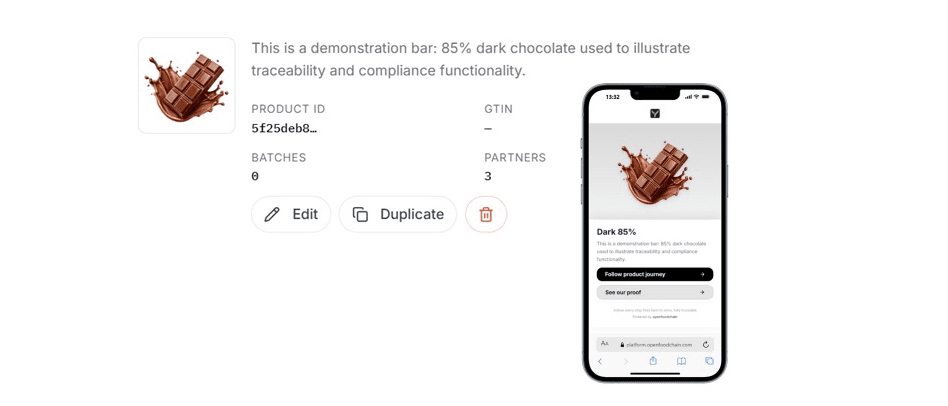
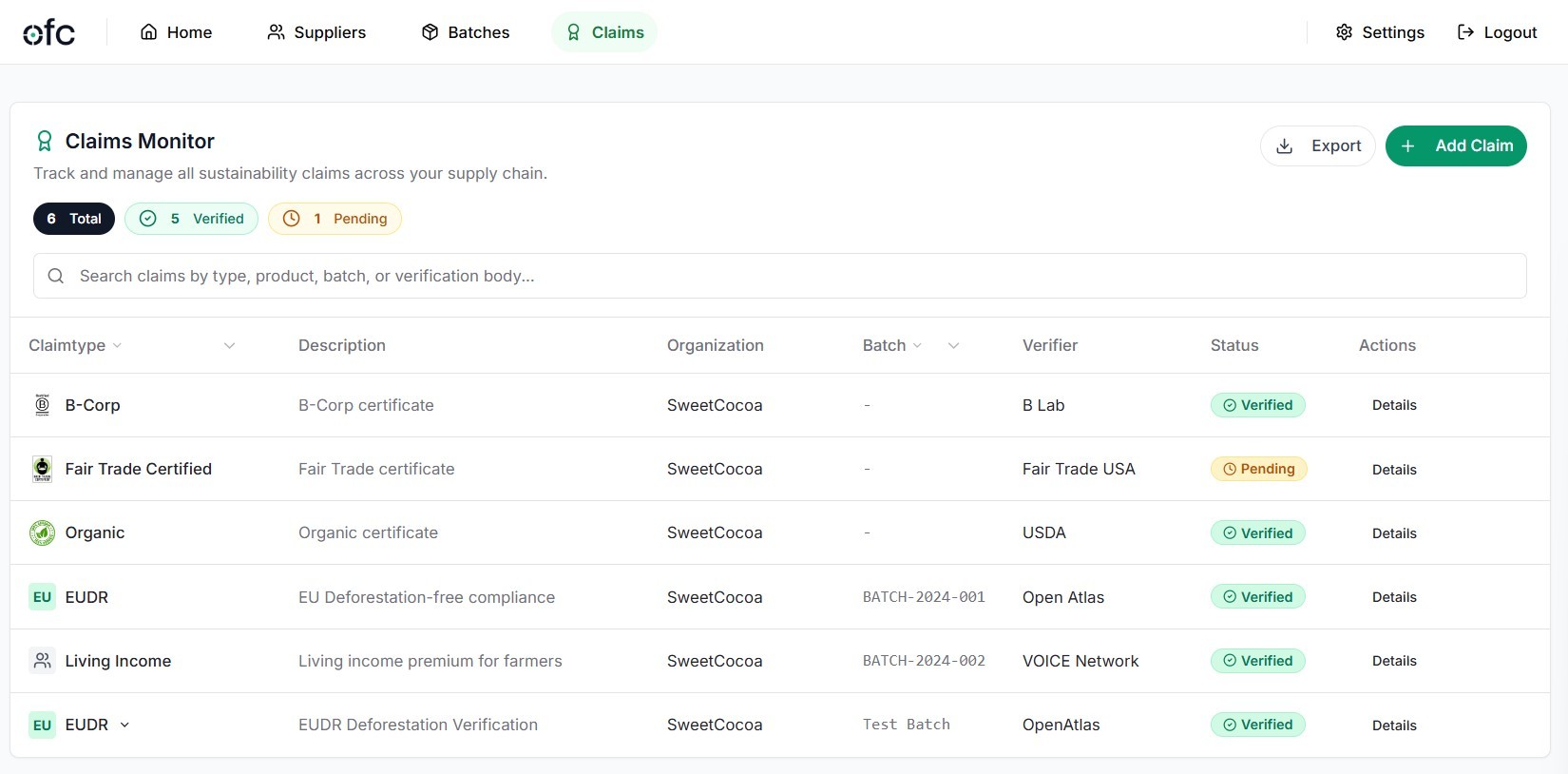
In Open Food Chain, each public claim links to its product, batch, evidence source and review status. Every claim is versioned, so nobody can edit one silently, and an on-pack QR code opens a batch-level product passport.
The rewrite goes on the pack, while the contract or certificate sits one scan away for customers, retailers and your adviser. We keep audit-ready evidence, run regulatory checks through specialist partners, and do not certify claims or guarantee compliance. The same records feed your EUDR exports: validate once, use many times.
See a claim, its evidence and its batch in one place on our claims page, and get a demo account with a passport pre-filled from public information. If your packs carry an ethical badge, read whether sustainability labels are now banned next.
This article is general information, not legal advice. Check your own situation with your national authority or a legal adviser.
Frequently asked questions (FAQs)
Does EmpCo apply to B2B communication?
No. EmpCo amends the rules on business-to-consumer practices, so a sales sheet sent only to a retail buyer falls outside it. Wording you reuse on a pack, a shop page or a consumer ad falls inside, so check B2B copy before it is repurposed for shoppers.
Can I still say "Fairtrade Certified" or "Rainforest Alliance Certified"?
Yes, if the certification is valid for that product and you follow the scheme's own labelling rules. The scheme also has to meet the directive's definition of a certification scheme, including independent third-party monitoring, which the major schemes publish details of on their websites.
Does "Green" in my brand name count as a claim?
Not automatically. The Commission's Q&A says "green" alone does not make a name an environmental claim, but terms such as "eco" or "natural" can if they create an environmental association for the average consumer, and then the detail has to appear on the pack. Certified organic products can still use "bio" or "eco" to show organic status. Renaming is rarely needed, but the rest of the pack should not lean on that association.
Is a certification logo enough on its own?
Usually not. A logo tells shoppers a scheme applies, but EmpCo bans whole-product claims that only cover one aspect, so make clear what the certification covers, such as the cocoa rather than the whole bar. Certification also does not prove EUDR compliance, as our Rainforest Alliance guide explains.
What should I fix first on existing packs?
Start with anything banned in all circumstances: offset-based climate claims, generic words like "sustainable" and self-certified badges. Next, check one-aspect claims such as "plastic-free" on mixed packaging. Origin facts usually need the least work, provided your batch records back them up.